
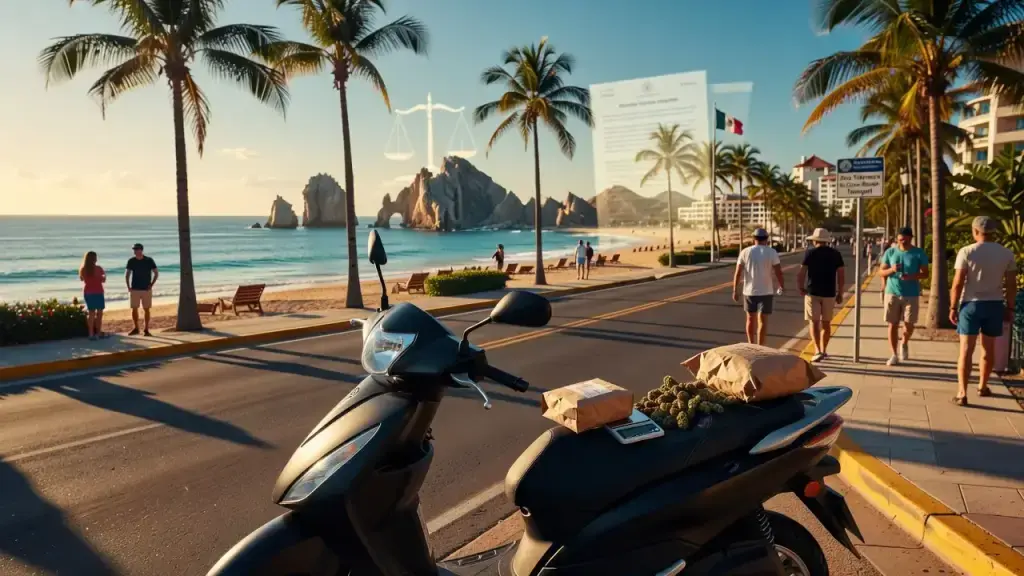
No dispensary in Mexico holds a retail license to sell THC products, and yet cannabis moves through the Los Cabos corridor every day via delivery services operating in a legal gap that neither Mexican statute nor tourist expectation has fully resolved. That gap, between a constitutional right to personal use and the total absence of a regulated supply chain, is the real story here, and it carries consequences for travelers, for local operators working without a licensing framework, and for anyone trying to assess risk honestly.
A Court Ruling, Not a Regulated Market
Mexico's Supreme Court issued its General Declaration of Unconstitutionality on adult recreational cannabis use in June 2021, an 8-3 decision that struck down federal prohibition as applied to individual adults. That is a meaningful legal fact. What it is not, is legislation creating a licensed retail channel. No seed-to-sale tracking system exists in Mexico. No METRC-equivalent compliance infrastructure, no state-sanctioned cultivation licenses feeding a wholesale menu, no point-of-sale terminal anywhere ringing up a legal THC transaction. The court cleared a constitutional path; Mexico's legislature has not built the regulatory apparatus to walk it. That distinction, between a right recognized by the judiciary and a market authorized by statute, is exactly what gets lost in most tourist-facing content.
Gray-Market Delivery Fills a Vacuum It Was Never Designed to Fill
Delivery services across Los Cabos operate without licensing, without lab testing requirements, without compliant packaging standards, and without any COA backing up what's actually in the product. That matters for consumer safety in a way that's easy to gloss over. In a regulated U.S. adult-use market, a dispensary's inventory has moved through batch testing, labeling rules, and a compliance log that a regulator can audit. None of that exists in Cabo's delivery economy. A buyer has no verified potency data, no contaminant screening, and no recourse if a product doesn't match what was promised. That's not a reason to panic, but it is a reason to treat any gray-market transaction as fundamentally unverified, closer to an unregulated purchase than anything resembling a licensed dispensary experience.
Where CBD Fits, and Where It Doesn't
Resort spas offering hemp-derived CBD treatments and low-THC wellness products occupy a genuinely different legal category, one that can align with Mexican sanitary rules for cannabinoids under 1% THC. That's a lower-risk category precisely because it isn't psychoactive cannabis and isn't competing with any illegal commercial THC trade. Conflating a CBD cocktail menu with an open THC retail market overstates how far resort tolerance actually extends. The two should not be treated as points on the same continuum; they sit in separate regulatory lanes entirely.
Enforcement Discretion Is Not a Compliance Framework
Baja California Sur's tourist zones show real tolerance for small personal quantities, generally amounts that fall under or near the historical 5-gram threshold used in Mexican federal health law. Some legal analysts argue post-2021 jurisprudence supports higher personal-use amounts, up to 28 grams in some readings, but that interpretation has not been codified. Tourists operating on assumed thresholds are relying on informal enforcement culture, not statute. Quantities that suggest distribution, legally benchmarked around 200 grams, move a case into trafficking territory with federal penalties attached. And cross-border transport carries zero exceptions: cannabis bought or used anywhere in Mexico cannot legally travel back across any border, a rule the U.S. State Department reiterates without ambiguity. For an industry built on documentation, manifests, lab reports, tax filings, it's worth noting that Cabo's cannabis economy runs on the near-total absence of all three.