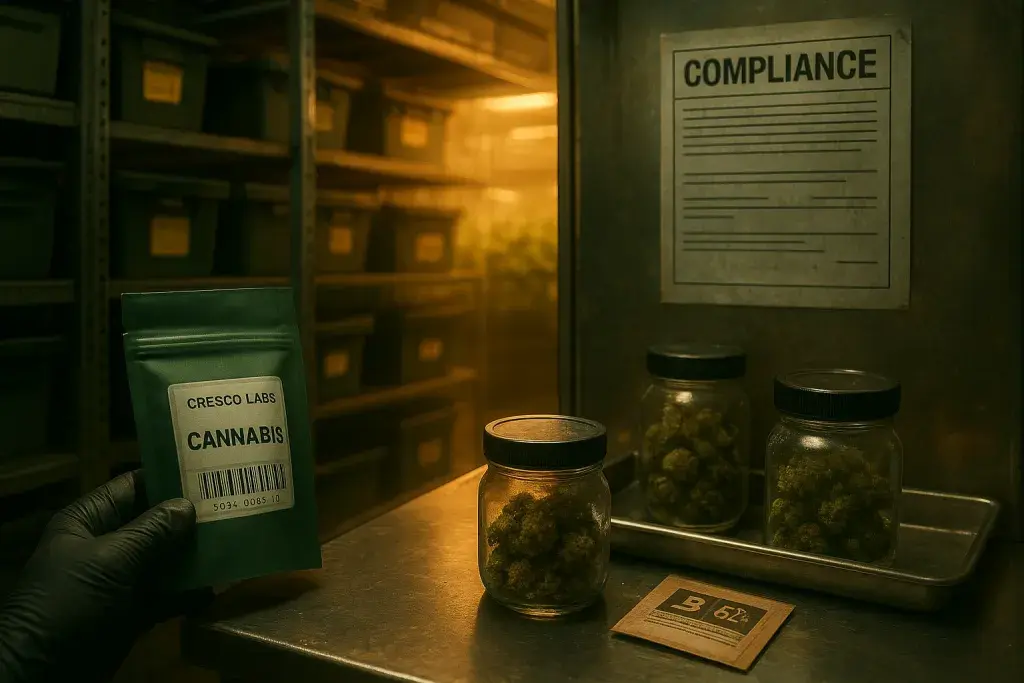
For the first time, a major multi-state cannabis operator has formally registered medical cannabis facilities with the U.S. Drug Enforcement Administration - a direct consequence of the federal government's rescheduling of marijuana to Schedule III under the Controlled Substances Act. Cresco Labs, operator of the Sunnyside dispensary chain and one of the larger vertically integrated cannabis companies in the United States, announced that it has completed DEA registrations covering dispensary, cultivation, and processing operations tied to its medical cannabis business. The move marks a concrete, procedural shift in how federally regulated compliance intersects with state-licensed cannabis operations - and operators across the industry are watching closely.
What the DEA Registration Pathway Actually Means
The rescheduling of medical cannabis from Schedule I to Schedule III did not legalize cannabis under federal law in any broad sense. What it did was create a defined regulatory mechanism - a 60-day expedited registration pathway - allowing eligible state-licensed medical cannabis operators to register specific activities with the DEA. Think of it less as federal approval and more as federal acknowledgment: the DEA now has a formal record of certain Cresco Labs facilities conducting cultivation, processing, and dispensing of medical cannabis.
That distinction matters. Schedule III classification means the substance is still a controlled substance, still subject to federal oversight, and still carries compliance obligations - just under a less restrictive federal framework than Schedule I. For operators, what changes is the relationship to that federal framework. Where there was previously no sanctioned registration pathway at all, there is now one. That's not a trivial development.
The 60-day expedited process itself signals that the DEA anticipated a wave of applications from the industry and built an intake mechanism accordingly. Whether that mechanism scales cleanly across hundreds of multi-state operators with complex licensing footprints remains to be seen in practice.
Operational and Compliance Implications for Multistate Operators
Cresco Labs' registration covers facilities across its medical cannabis footprint - spanning dispensary retail, cultivation, and processing. For a vertically integrated operator, that's a meaningful scope. Each operational tier - from grow facility to processing lab to dispensary floor - carries its own compliance profile at the state level. Layering DEA registration on top of existing state licensing requirements adds a new federal compliance thread that operators will need to track alongside seed-to-sale reporting, state inspection cycles, and license renewal timelines.
Here's the operational pressure point: most cannabis compliance infrastructure - METRC integrations, point-of-sale systems, inventory management platforms, and compliance logs - was built entirely around state regulatory requirements. Federal registration introduces a new reporting and record-keeping relationship that existing software stacks were not designed to accommodate. Compliance teams at multistate operators will need to assess what, if anything, DEA registration requires in terms of ongoing documentation, reporting intervals, or operational standards that differ from what their state programs already mandate.
For smaller single-state operators or medical-only licensees, the calculus is different. The registration pathway is technically available to any eligible state-licensed medical cannabis operator, but the administrative capacity to manage federal registration - on top of existing state compliance burdens - is not evenly distributed across the industry. Large operators like Cresco Labs have dedicated regulatory affairs teams. A single-location medical dispensary in a mid-sized market may not.
The Broader Regulatory Signal
What Cresco Labs' CEO described as "federal recognition" of the company's work is, at minimum, accurate as a procedural matter. Whether DEA registration translates into downstream business benefits - access to banking, relief from Section 280E tax treatment, or smoother relationships with payment processors - is a separate question, and not one the rescheduling itself resolves cleanly.
280E, for instance, remains a serious tax burden for cannabis operators because it disallows standard business deductions for companies trafficking in Schedule I or II substances. Schedule III reclassification theoretically removes cannabis from that category - but the IRS has not issued final guidance, and the legal and accounting community is still working through what rescheduling means in practice for tax year treatment. Banking access under the Bank Secrecy Act and FinCEN guidance is similarly unsettled. Rescheduling is not SAFE Banking. Those are different instruments with different legislative histories.
The thing is, DEA registration as a compliance milestone and DEA registration as a commercial unlock are not the same event. Operators who treat them as equivalent risk misreading where the regulatory uncertainty actually sits.
What the registration does accomplish, practically and symbolically, is establishing a paper relationship between a state-licensed cannabis business and a federal agency - something that did not exist in any formal sense before. For compliance professionals, that paper trail has value independent of the policy debate. It creates a documented record of operation under a federally recognized framework, which could matter in licensing disputes, financing conversations, or future regulatory proceedings.
What Other Operators Should Be Tracking
Cresco Labs moving first on DEA registration is likely to accelerate similar filings from other multistate operators with medical cannabis licenses. The competitive and reputational dynamic in regulated cannabis markets means that compliance posture signals matter - to investors, to state regulators, and to institutional partners. Being registered with the DEA under the new Schedule III framework is, for now, a differentiator. It will not be for long if the pathway remains open and accessible.
Operators considering their own registration filings should be tracking several practical questions: which specific facility types and activity categories are eligible under the 60-day pathway; what record-keeping obligations accompany DEA registration at the facility level; how state regulatory bodies in their markets are interpreting the interaction between state licensing and federal registration; and whether their existing compliance software can generate the documentation a DEA-registered facility may eventually require.
The rescheduling of medical cannabis to Schedule III is, by most measures, the most significant structural shift in federal cannabis policy in decades. DEA registration is the first concrete, operational expression of that shift at the facility level. It is not the finish line - but it is, demonstrably, a start.