The Drug Enforcement Administration's administrative law judge has issued a formal scheduling order for the upcoming marijuana rescheduling hearing, setting proceedings to begin June 29 and run through July 15, 2026. The order assigns eight designated parties - each one an opponent of the proposed transfer of cannabis from Schedule I to Schedule III of the Controlled Substances Act - specific presentation dates across a two-and-a-half-week window. For licensed cannabis businesses watching the federal regulatory horizon, this hearing represents the most consequential formal proceeding on marijuana's legal status in decades.
What makes the hearing structurally unusual - and, for many in the industry, deeply concerning - is who isn't in the room. The DEA administrator made a deliberate decision to invite only opponents of rescheduling, excluding reform supporters who submitted requests to participate. No licensed dispensary operators, cannabis trade associations, multi-state operators, or patient advocacy groups appear on the schedule. Operators running dispensary software in Maryland or any other regulated state market have zero formal representation in a proceeding that could define whether their businesses operate under Schedule I or Schedule III federal law - a distinction with direct consequences for tax treatment, banking access, and operational compliance. That's not a procedural footnote. It's the entire framing problem.
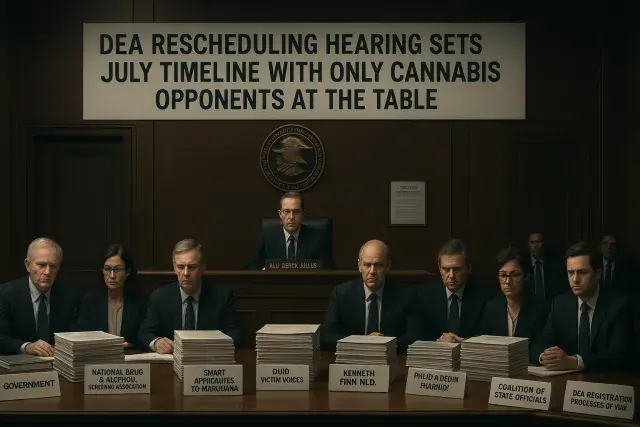
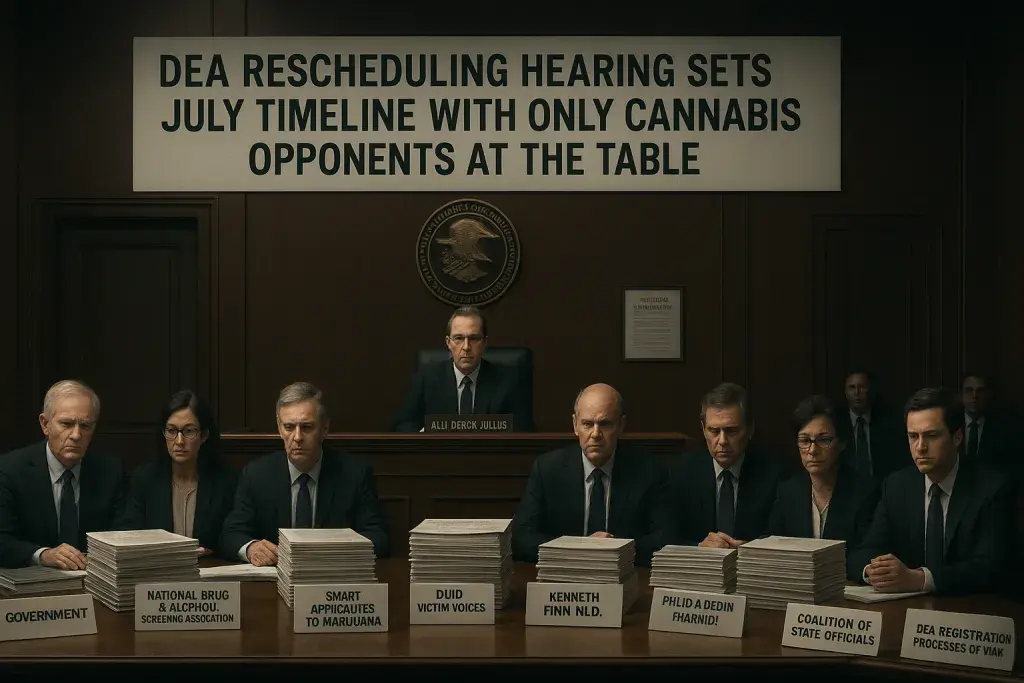
The scheduled participants, in order of appearance, are: the Government (June 29), the National Drug & Alcohol Screening Association (July 2), Smart Approaches to Marijuana (July 6), DUID Victim Voices (July 7), Kenneth Finn, M.D. (July 8), the Tennessee Bureau of Investigation (July 10), Phillip A. Drum, PharmD (July 13), and a coalition of states - Nebraska, Idaho, Indiana, and Louisiana - on July 14. The DEA itself is technically the proponent of the rescheduling rule, meaning it will defend the proposal during the hearing even as the other parties argue against it. ALJ Derek Julius's order notes that parties may conclude early and that the hearing will advance accordingly, with day-to-day scheduling adjustments as needed.
The DEA's Dual Role Creates Real Tension
Here's the catch: the DEA is simultaneously the agency that has historically resisted cannabis reform most aggressively and the party now tasked with defending the rescheduling proposal on the record. Reform supporters have openly questioned whether the agency will mount a vigorous defense of the rule - and the skepticism is grounded in institutional history, not speculation. The agency's decades-long posture toward cannabis prohibition doesn't vanish because the current administration directed it to take the opposite position in a hearing room.
There's a wrinkle on that front, though. The DEA is reportedly resisting Smart Approaches to Marijuana's attempt to call a DEA pharmacologist as a witness - the same official who previously submitted a report into the record during the Biden-era hearing linking cannabis to psychosis, depression, and impaired cognitive functioning. The DEA's resistance to that witness request may suggest the agency intends to present a more limited case focused on administrative process rather than harms-based prohibition. Whether that reading holds up once testimony begins is another matter entirely.
Transparency Fight Adds Another Complication
ALJ Julius's preliminary order prohibits the hearing from being televised, livestreamed, or broadcast in any form. Attendance is limited to those who can physically appear in Arlington, Virginia. That's a meaningful departure from the Biden-era hearing process, which did permit livestreaming. Marijuana Moment has formally asked the judge to reconsider, with counsel arguing that limited physical seating isn't a substitute for public access and that delayed transcript release doesn't allow for real-time press coverage of a proceeding with national policy implications. The judge has not yet responded publicly to that request.
For cannabis businesses, the transparency question isn't abstract. Dispensary operators, compliance officers, wholesale suppliers, and cannabis software vendors have real business decisions riding on how this hearing unfolds - decisions about tax strategy, banking relationships, inventory planning, and licensing under evolving federal rules. Without contemporaneous public access to the proceedings, the industry is left parsing secondhand accounts of testimony that could reshape the federal regulatory framework it operates within.
What Rescheduling Already Means for Licensed Operators
Acting Attorney General Todd Blanche's April order has already moved state-licensed medical cannabis to Schedule III, producing immediate downstream effects. The IRS has announced it will issue new 280E tax guidance - the provision that currently bars cannabis businesses from deducting ordinary business expenses has no applicability to Schedule III substances, meaning licensed operators could eventually recoup meaningful tax relief. The ATF has drafted revisions to federal gun purchase forms acknowledging the changed status of medical cannabis. The Bureau of Alcohol, Tobacco, Firearms and Explosives' updated language specifies that only recreational marijuana use remains federally prohibited under the revised classification.
The DEA has also opened a registration process allowing state-legal cannabis businesses to access federal benefits tied to the Schedule III designation - a notable move from an agency that not long ago was accused of deliberately slowing the reform process. The Department of Transportation, in contrast, has made clear that a Schedule III designation doesn't change drug-testing rules for safety-sensitive transportation workers. Federal regulatory consistency, in other words, remains a long way off.
The hearing itself faces legal pressure from multiple directions. Lawsuits challenging the rescheduling process - filed by state attorneys general, legalization opponents, and a cannabis-focused biopharmaceutical company - have been consolidated at the federal appellate level. A congressional committee has voted to block further federal action on rescheduling. The Biden-era hearing process collapsed under litigation over alleged procedural irregularities. This proceeding is not operating in a stable environment, and anyone who tells you the outcome is predictable isn't paying close attention.
For licensed cannabis businesses, the operative posture right now is watch, document, and plan for multiple scenarios - because the federal regulatory ground under this industry has not finished shifting.