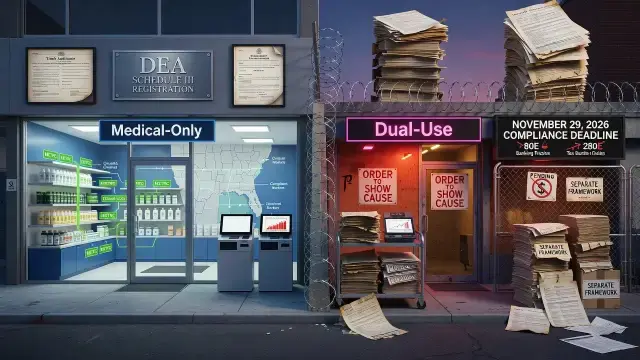

Three DEA actions landed within days of each other, and together they draw a sharper line than regulators have drawn before between medical-only cannabis markets and the dual-use states that make up most of the legal industry. The agency issued guidance on what "Timely Applicants" may do while their registrations sit pending, proposed denying a Minnesota dispensary's application, and granted its first batch of federal registrations - all in states without adult-use sales. For operators in combined medical and recreational markets, the pattern is hard to ignore.
A Closed Loop With Real Teeth
The guidance confirms something operators have assumed since the 60-day application window closed in June: filing on time lets you keep dispensing, manufacturing, or distributing schedule III medical marijuana under your state license while DEA reviews your paperwork. That's the good news. The catch is who you're allowed to trade with. Timely Applicants may only transact with other Timely Applicants, identified by DEA control number, or with entities that already hold a schedule III registration. Anyone who missed the window, or never applied, is now effectively off-limits as a counterparty.
That restriction isn't cosmetic. DEA has stated that transacting with a non-qualifying entity can be grounds for denying a pending application or revoking a registration already granted. Operators are expected to verify counterparty status before every transaction, not just at onboarding, and to document that diligence the same way they'd document supplier vetting for a suspicious-orders policy. DEA has given Timely Applicants until November 29, 2026, to get their supply chains into compliance, though existing inventory from non-qualifying sources can still be sold through in the meantime - a carve-out the guidance extends to dispensaries and distributors but, notably, not to manufacturers.
Why Minnesota Matters Beyond Minnesota
The Order to Show Cause against a Minneapolis dispensary cited three grounds for denial, but the broadest one should worry operators well outside that state. DEA argued that Minnesota's dual-purpose license - covering both medical and non-medical dispensing - doesn't meet the definition of a "state medical marijuana license" and fails to provide the "robust protections" against diversion that federal registration requires. The agency tied this back to the Single Convention's requirement that registration be grounded in actual medical prescribing, not general adult access.
The other two grounds are narrower and specific to Minnesota's program design: the state allows veterans to self-attest to qualifying status without a practitioner's certification, and it permits dispensing of synthetic and artificially derived cannabinoids that remain in Schedule I. Those are fixable program details. The diversion language is not - it reads as a statement about dual-use licensing structures generally, and that's the part that should get attention in Illinois, New Jersey, Michigan, and every other state running medical and adult-use programs side by side.
What the First Registrations Signal
DEA's first round of registrations went to dispensaries in Alabama, Florida, Mississippi, South Dakota, Texas, Virginia, and West Virginia - every one a medical-only market, or in Virginia's case, a state where adult-use sales haven't started. Meanwhile, reporting suggests several thousand timely applicants sit in dual-use states with no registrations issued yet, and some accounts indicate DEA may be inclined to reject Schedule III applications from those markets outright. Nothing here is a formal denial of dual-use operators as a class. But the absence of any registration in a mixed-use state, paired with the Minnesota order's language, is not a coincidence an operator should ignore.
- Medical and adult-use inventory must stay separately tracked, often through METRC tags, with clear records showing medical-designated product moved only through medical channels.
- State rules on wholesaling between adult-use cultivators and medical dispensaries vary widely - New Jersey permits certain cross-selling arrangements that other states prohibit entirely.
- Operators should audit how their state's licensing structure compares to Minnesota's before an order to show cause arrives, not after.
For dual-use operators, the guidance effectively mandates a split supply chain: a closed federal loop for medical activity, and adult-use operations that remain entirely outside the registration framework and get no protection from it. That's a real operational burden - separate ordering systems, separate diligence files, separate point-of-sale reporting where state law requires it - layered on top of the 280E tax exposure and banking friction these operators already manage. None of this resolves the underlying question of whether a state's dual-use structure can ever satisfy DEA's reading of the Single Convention. Until DEA registers someone in a mixed-use market, that question stays open, and every applicant in one of those states is, in effect, waiting to find out how it gets answered.