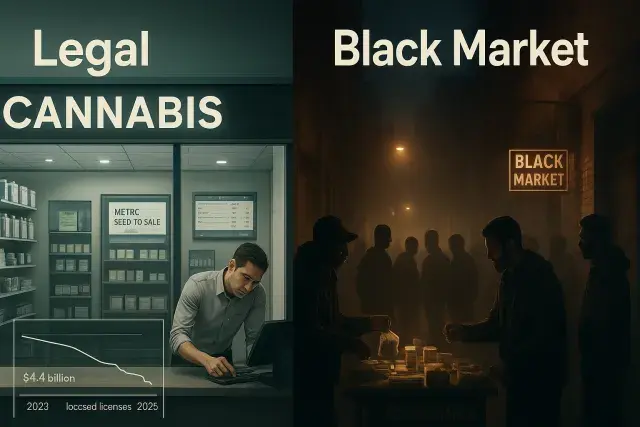
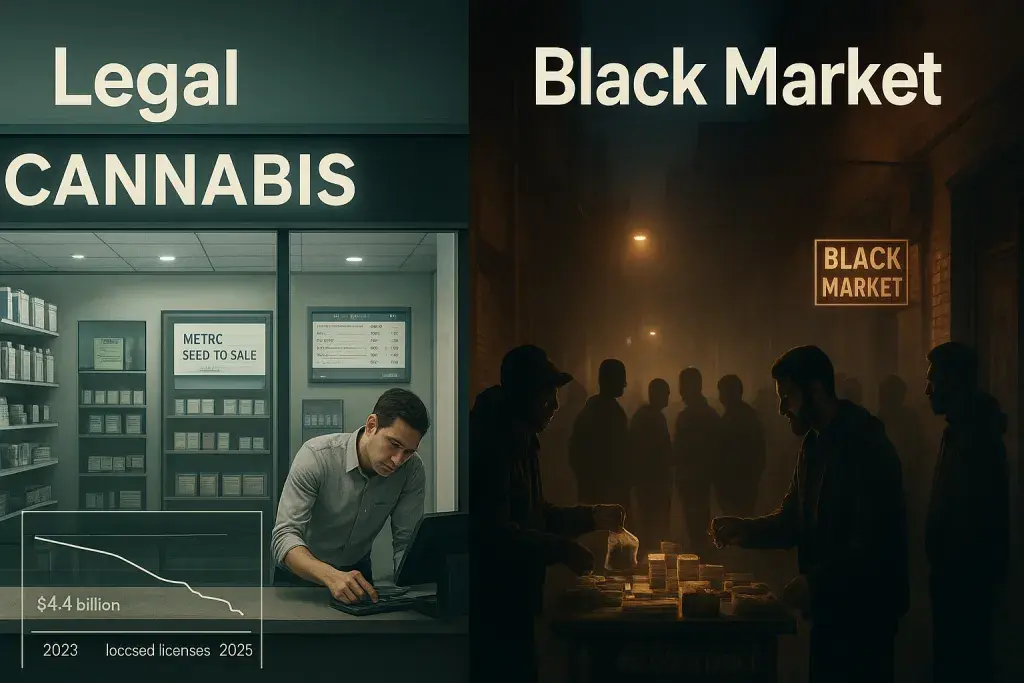
The regulated cannabis industry was built on a straightforward premise: bring the market into the light, and the underground economy would wither. That hasn't happened. National consumption data shows use continuing to climb - past-month users in the United States rose from roughly 37 million in 2021 to more than 44 million in 2024, according to SAMHSA - while California's licensed market posted three consecutive years of declining sales, dropping from approximately $4.4 billion in 2023 to an estimated $3.9 billion in 2025. Growing demand and shrinking legal sales point in one uncomfortable direction: a larger share of consumption is flowing outside the licensed system.
For dispensary operators, multi-state operators, and the vendors who serve them, that divergence isn't abstract. It shows up in wholesale pricing pressure, softening foot traffic, abandoned SKUs, and POS systems logging fewer transactions per day. Compliance infrastructure - seed-to-sale tracking through METRC, compliant packaging, mandatory lab testing, COA documentation, excise tax remittance - carries fixed costs that don't compress when revenue drops. Operators in markets with high effective tax burdens, such as California's combined state and local rates that can push the total tax load well above 30% of retail price, are structurally unable to match the street price of unregulated product. Platforms designed to help licensed retailers manage inventory, customer data, and compliance obligations - from cannabis pos software maryland deployments to California multi-license operators - are serving businesses that are, in many cases, losing the price war before a single transaction is rung up. The cost structure of legal retail is not a solvable operational problem. It is a policy design problem.
The Licensed Market as Customer Acquisition for the Unregulated One
Here's the catch nobody in the legalization coalition wanted to say out loud: the regulated industry spent years normalizing cannabis consumption, building aspirational brands, staffing attractive retail storefronts, and training a generation of first-time adult-use consumers. That's not a criticism of individual operators - it was the model. The problem is what happens next. Once a consumer is comfortable purchasing cannabis, the transaction itself becomes routine. At that point, price matters. Illegal operators carry none of the compliance overhead that licensed retailers are required to absorb: no licensing fees, no mandatory testing costs, no track-and-trace compliance, no security mandates, no 280E federal tax treatment, no local cannabis tax on top of state excise. Their margin structure is completely different. So they undercut. And they can keep undercutting.
The result, by some estimates, is that more than 60% of cannabis consumed in California still moves outside the licensed system. That figure, if accurate, means the legal market - despite years of expansion and hundreds of millions of dollars in infrastructure investment - has not captured the majority of the consumer base it was designed to serve. More than 10,000 cannabis licenses in California have been surrendered or gone inactive, exceeding the number of currently active licenses. Tax revenues that municipalities built into budget projections are now declining. San Diego's cannabis tax collections have fallen from post-legalization highs. Cannabis-sector equities have suffered severe losses - one major cannabis-focused fund reportedly posted a return of negative 67.40% for the fiscal year ended June 30, 2025, against an S&P 500 gain of roughly 15% over the same period. Investors have noticed.
What This Means for Operators Still in the Licensed System
Dispensary owners who remain in the regulated market are managing a difficult position. Their compliance obligations don't shrink because the competitive environment has gotten harder. Seed-to-sale tracking requirements, mandatory lab testing cadences, compliant packaging specifications, delivery manifest accuracy, and point-of-sale audit trails are not optional based on revenue performance. The regulatory burden is fixed. The revenue is not.
What changes in a contracting market is where the pressure concentrates. Wholesale menus compress as cultivators and processors fight for shelf space in fewer active retail accounts. Operators thin out their SKU counts, cutting slower-moving products to reduce carrying costs and inventory shrinkage. Brands with thin distribution deals find themselves competing harder for budroom floor space in stores that are themselves losing volume. Vertical integration, where it's permitted, becomes more attractive as a cost-management tool - controlling more of the supply chain is one of the few levers operators can actually pull. None of this solves the underlying price gap with the unregulated market, but it can keep a licensed business viable while the policy environment - tax rates, license caps, social equity program structures, enforcement funding - either catches up or doesn't.
The Policy Gap No One Is Closing Fast Enough
The structural problem is straightforward to describe and genuinely difficult to fix. The legal market cannot compete on price with unlicensed operators as long as the tax and compliance cost differential remains this wide. Reducing excise tax rates and municipal cannabis taxes would narrow the gap but reduce the revenue that legalization was supposed to deliver - the same revenue now declining anyway as legal sales fall. Increasing enforcement against illegal operators is the other lever, but it requires sustained political will and dedicated funding that most jurisdictions have not committed. California has made enforcement gestures; the illegal market's market share suggests those gestures have not been decisive.
The uncomfortable reality for the B2B cannabis ecosystem - POS vendors, compliance software providers, payment processors trying to serve the industry, real estate landlords holding dispensary leases, packaging suppliers, lab testing facilities - is that the customer base they built their businesses around is operating in a market that is structurally smaller than projected and shrinking in the states where it has been legal the longest. The promises made to regulators, to investors, and to the public about what legalization would produce have not been kept. That isn't an argument for any particular policy correction. It is, however, a clear-eyed accounting of where the industry actually stands - and what anyone still in it needs to plan around.