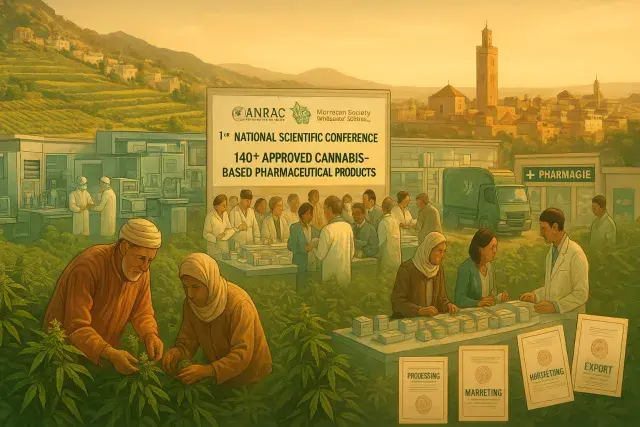
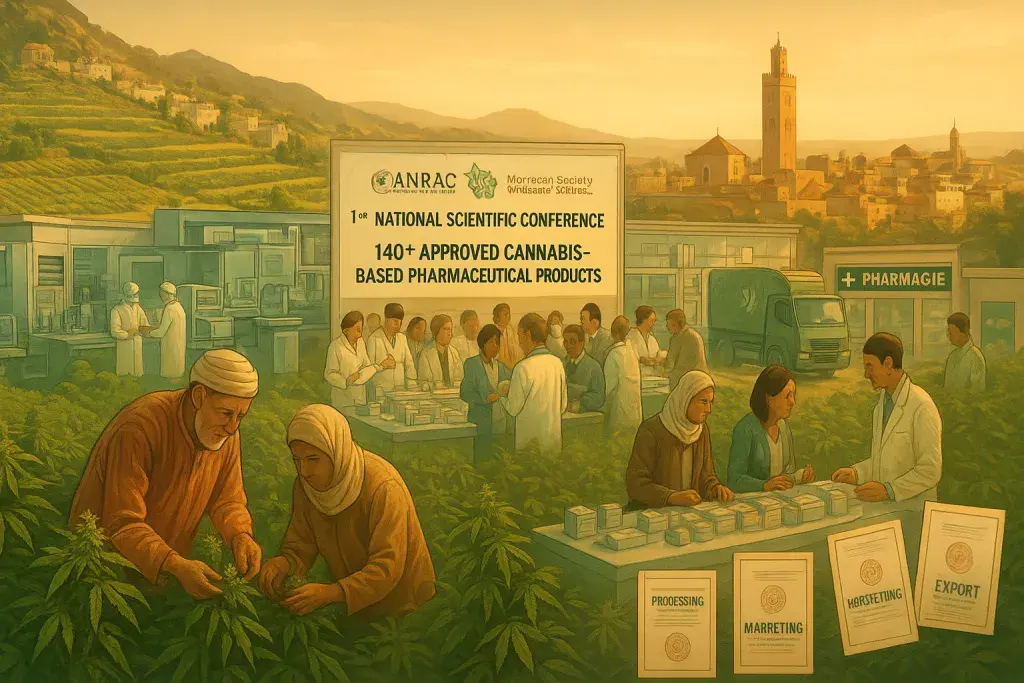
Morocco's legal cannabis sector has crossed a meaningful threshold. Five years after the country enacted Law No. 13-21 - the legislation that opened the door to licensed cultivation, processing, and pharmaceutical production - the national regulatory body is reporting figures that suggest the framework is doing more than holding paper. More than 140 cannabis-based products, manufactured by Moroccan pharmaceutical laboratories and approved by the Moroccan Agency for Medicines and Health Products (AMMPS), are now available through more than 600 authorized outlets across the country. The announcement came at the first national scientific conference on therapeutic cannabis use, organized in Rabat by the National Agency for the Regulation of Cannabis-Related Activities (ANRAC) and the Moroccan Society of Medical Sciences.
What makes Morocco's trajectory worth tracking for international cannabis industry observers - including operators and investors in more mature regulated markets - is the pace at which the country is building a traceable supply chain from the ground up. That is not a small thing. Building traceability infrastructure from scratch, with no legacy systems to integrate, is a problem that has dogged regulated markets elsewhere. In Nevada, for instance, operators spent years reconciling legacy inventory processes with state-mandated tracking requirements; companies offering dispensary pos software nevada had to engineer compliance workflows that could handle both the business logic of retail and the audit requirements of regulators simultaneously. Morocco is starting with pharmaceutical-grade approval frameworks baked into the authorization process rather than bolted on after the fact - a structural choice that carries real operational implications downstream.
The Supply Side: Scale, Licensing, and the Shift From Informal to Regulated
The production figures ANRAC released for 2025 are substantial. According to the agency, Morocco produced nearly 2,000 tons of dried cannabis this season - roughly 10% more than the prior year. The licensing system now covers 5,765 active licenses for the 2025 season. Of those, 5,492 are cultivation permits held by more than 5,300 individual farmers. The remaining licenses span processing, transportation, marketing, exports, and seed imports.
That breakdown matters. It's not simply a headcount of licensees - it's a picture of how deliberately Morocco is constructing each segment of its supply chain as a separately licensed, separately accountable category. That kind of segmented licensing structure is familiar to anyone who has worked in a vertically integrated cannabis market, where a single multi-state operator might hold cultivation, processing, and retail licenses as distinct regulatory authorizations under one corporate umbrella. Morocco is applying the same logic, but across thousands of smallholder farmers rather than consolidated corporate entities. The compliance burden per node is lower; the coordination challenge across nodes is considerably higher.
For authorities, the overarching goal is explicit: transition a historically informal economy - Morocco has been one of the world's largest producers of cannabis resin for decades - into a regulated, traceable industry capable of meeting pharmaceutical standards and international export requirements. That is a supply-chain transformation problem as much as a regulatory one. Informal production has no COA documentation, no batch tracking, no standardized post-harvest processing. Building those systems into the workflows of thousands of small farmers, spread across traditional growing regions, requires more than a licensing portal. It requires sustained field-level compliance infrastructure.
The Pharmaceutical Channel: What 600 Authorized Outlets Actually Signals
The distribution footprint - more than 600 authorized outlets carrying AMMPS-approved products - deserves context. This is not a recreational dispensary network. These are pharmaceutical distribution points, operating under health ministry authorization, carrying products that have cleared a formal approval process managed by a national medicines regulator. The 140-plus registered SKUs reflect a manufacturing base that has, at least on paper, met pharmaceutical-grade production standards.
Here's the catch, though. Approval and availability are not the same as market depth. A product can sit on a pharmacy shelf and move slowly, particularly when physician familiarity with the category is still developing and patient-facing education is limited. The fact that ANRAC organized its first-ever national scientific conference on therapeutic cannabis use in 2025 suggests that building clinical awareness is still a work in progress. That's not a criticism - it's a sequencing reality. Regulatory frameworks tend to outpace clinical adoption curves, particularly in markets where cannabis was previously associated exclusively with illegal production.
For international cannabis brands or pharmaceutical companies watching Morocco's pharmaceutical channel develop, the distribution architecture itself is the asset worth studying. An authorized, pharmacist-mediated point of sale with product-level regulatory approval is a more defensible commercial position than a retail dispensary model dependent on adult-use foot traffic and promotional marketing. The margin structure looks different, and so does the compliance overhead - but the channel stability is potentially more durable.
What the Moroccan Model Tells Regulated Markets About Transition
Morocco's five-year arc from law to licensed pharmaceutical shelf demonstrates something that operators in newer regulated markets often learn the hard way: regulatory legitimacy does not arrive all at once. It accumulates - license by license, approved product by approved product, authorized outlet by authorized outlet.
The 10% production increase year-over-year, while modest, is precisely the kind of incremental signal that suggests a supply chain is stabilizing rather than spiking. Uncontrolled production spikes create oversupply, which collapses wholesale pricing and pushes marginal operators back toward informal channels. Morocco appears to be managing supply growth at a pace its licensed processing and distribution infrastructure can absorb. That discipline is harder to maintain than it sounds.
For B2B observers - whether software vendors, compliance consultants, export-focused processors, or investors evaluating emerging cannabis markets - Morocco represents a relatively rare example of a country building pharmaceutical-grade cannabis infrastructure with explicit export ambitions from the outset. The licensing categories already include export licenses. The AMMPS approval process already mirrors international pharmaceutical standards in structure, if not yet in global recognition. The strategic intent, to put it plainly, is a regulated cannabis export economy. Whether execution keeps pace with that intent over the next five years is the question worth watching.