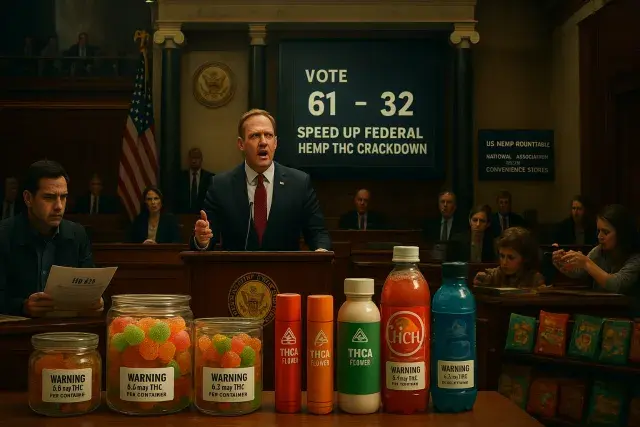
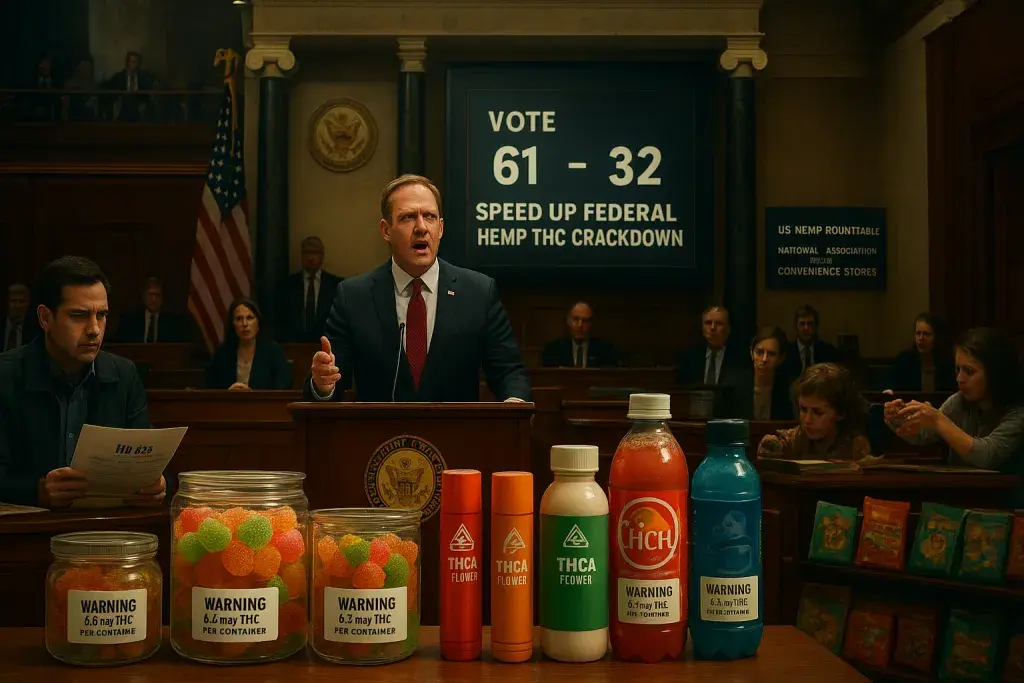
A vote to accelerate federal restrictions on intoxicating hemp products failed in the US Senate last week, leaving retailers, wholesalers, and brands with a narrow, temporary reprieve before a sweeping new THC threshold takes hold. Sen. Ted Budd, R-N.C., tried to strip a provision delaying the restrictions' effective date from Nov. 12 to Dec. 11, arguing that any additional delay protects an industry selling products he says are marketed to children. Senators voted 61-32 to table his amendment, meaning the 30-day delay survives, at least for now, inside the broader continuing resolution the Senate ultimately passed 90-6.
For dispensary operators and hemp retailers outside the traditional adult-use and medical cannabis markets, this fight matters because it touches products that have been sitting on convenience store shelves, gas station counters, and grocery aisles largely outside state cannabis licensing systems. Once the federal law takes effect, hemp will be redefined by total THC rather than delta-9 THC alone, and finished products exceeding 0.4 milligrams of combined THC and similar cannabinoids per container will fall outside the legal hemp definition entirely. That is a dramatically tighter standard than what most hemp beverage, gummy, vape, and THCA flower brands have operated under, and it will force reformulation, relabeling, or removal from shelves in states that have not built separate regulatory frameworks - a compliance scramble that licensed cannabis retailers, who already operate under seed-to-sale tracking, COA requirements, and strict packaging rules, have been navigating for years. States running mature regulated markets, including operators relying on systems like the point-of-sale for South Dakota dispensaries, already build compliance logging and age verification into daily transactions; unregulated hemp retail has not. point-of-sale for South Dakota dispensaries
Why the Delay Became a Flashpoint
Budd's argument rested on public safety: he cited a steep rise in cannabis-related emergency department visits among North Carolina minors and pointed to packaging that mimics popular snack and candy brands as evidence that intoxicating hemp products are reaching children through ordinary retail channels rather than age-gated dispensaries. That framing put him at odds with the White House, which backed the 30-day delay while pursuing what it describes as a broader regulatory framework, and with CMS Administrator Dr. Mehmet Oz, who warned that letting the restrictions take effect on schedule could disrupt recent efforts to expand senior and disability access to full-spectrum hemp-derived CBD. Budd pushed back, questioning why medical CBD access required continued retail sale of intoxicating products.
The opposition wasn't limited to the administration. A coalition of 105 organizations - including the US Hemp Roundtable, the National Association of Convenience Stores, and several North Carolina hemp and brewing groups - urged Senate leadership to preserve the delay, arguing it gives Congress room to legislate testing standards, packaging rules, and import restrictions on synthetic cannabinoids rather than simply banning most of the market outright. That's the crux of the disagreement: whether a strict THC threshold functions as consumer protection or as a de facto prohibition on products that, properly regulated, could operate more like state-licensed cannabis retail.
North Carolina's Parallel Deadlock
The federal fight mirrors a stalled effort in Raleigh, where House Bill 328 would write the same 0.4-milligram threshold directly into state law, along with a 21-and-older purchase requirement. The Senate approved the conference report 37-6 in July, but the House has repeatedly declined to act, and the bill now sits in the Rules Committee. House Speaker Destin Hall has acknowledged that lawmakers broadly agree the state's unregulated hemp market needs guardrails but remain split on the mechanism - a familiar tension for any state trying to fold a fast-growing hemp retail sector into something resembling licensed cannabis oversight, with age verification, lab testing, and inventory controls built in from the start rather than bolted on after the fact.
What Retailers and Suppliers Should Watch
- Whether Congress uses the 30-day window to pass substantive hemp regulation or simply runs out the clock before Dec. 11
- How multi-state hemp brands plan SKU-level reformulation to meet the 0.4-milligram total THC ceiling
- Whether states with pending hemp legislation, like North Carolina, adopt the federal threshold independently of what Congress ultimately decides
- How wholesale pricing and distribution contracts absorb sudden product delisting if the restrictions take effect with little additional notice
None of this resolves cleanly by Dec. 11. What's clear is that the gap between lightly regulated hemp retail and tightly compliant cannabis retail is narrowing, whether Congress intends that outcome or simply backs into it through a deadline nobody can quite agree how to handle.