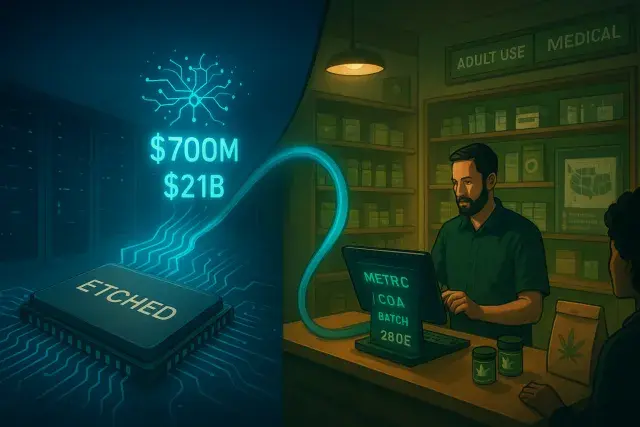
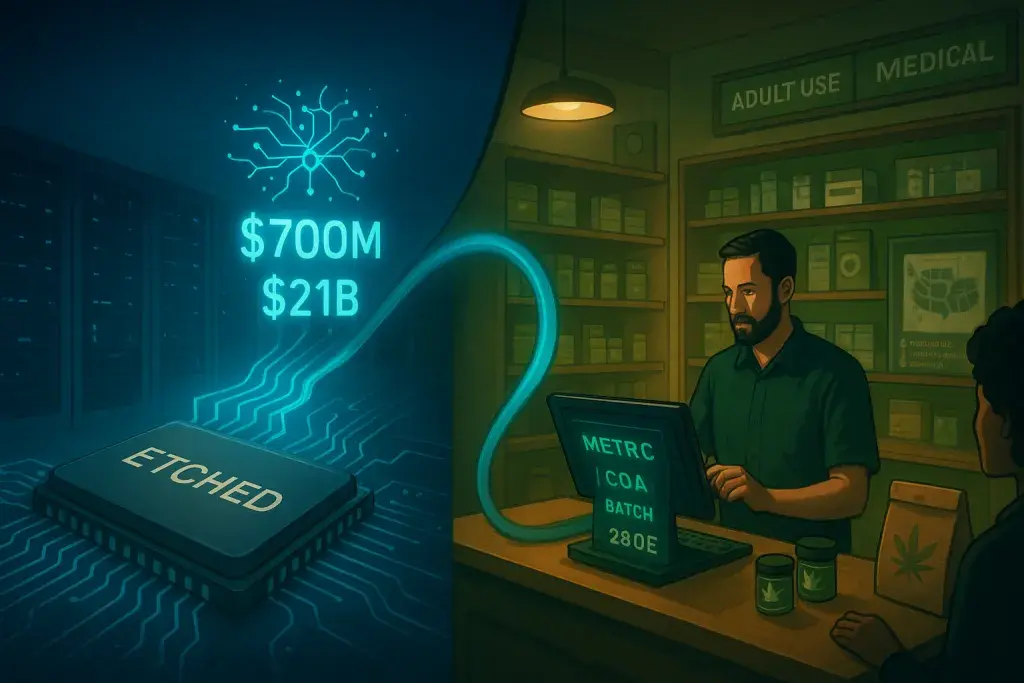
Cannabis retailers don't run on the kind of capital that just landed at an AI chip startup called Etched, which raised $700 million this week at a $21 billion valuation. But the underlying lesson - that back-end infrastructure decisions can make or break a business - applies just as directly to a dispensary counter in Denver as it does to a data center in Silicon Valley.
Here's the parallel worth drawing out. Etched built specialized hardware because generic chips couldn't handle its specific workload efficiently enough. Dispensary operators face a similar calculus every day when they choose their retail technology stack. A generic retail POS system wasn't built for METRC reporting, batch-level COA tracking, or the excise tax calculations that vary by jurisdiction. That's precisely why purpose-built point of sale systems for marijuana dispensaries colorado operators rely on exist as a distinct product category rather than an afterthought bolted onto standard retail software.
The thing is, infrastructure choices compound. A chip architecture optimized for one phase of computation but not another creates bottlenecks - that's the whole reason Etched says it engineered separate components for prefill and decode. Dispensaries face an analogous problem when their point-of-sale system handles transactions fine but chokes on compliance logging, inventory reconciliation, or seed-to-sale syncing during a busy Friday rush. Shrinkage goes unnoticed. Compliance logs fall behind. A regulator's audit request turns into a scramble instead of a routine export.
Compliance Infrastructure Isn't Optional Overhead
For adult-use and medical cannabis retailers alike, the software layer sits underneath every regulatory obligation: age verification at the point of sale, real-time inventory tracking tied to state traceability systems, compliant packaging confirmation, and tax withholding that has to survive an eventual 280E-related audit. None of that is glamorous. None of it attracts a venture round anywhere near what Jane Street just wrote for Etched. But operators who treat it as a line item rather than a foundation tend to discover the gap at the worst possible moment - during an inspection, not before one.
Scale Changes the Math, in Chips and in Cannabis
Etched's valuation jump reflects investor conviction that inference workloads will keep growing and that specialized hardware will outperform general-purpose alternatives at scale. Multi-state cannabis operators are living a smaller version of that same story. As store counts grow, the cost of a mediocre POS system stops being a minor annoyance and starts showing up in wholesale pricing decisions, SKU management errors, and reconciliation headaches across a delivery manifest that spans multiple licenses. Fair enough to shop on price for a single storefront. Less defensible once you're running a portfolio of dispensaries where one bad system multiplies every operational risk by the number of doors it touches.