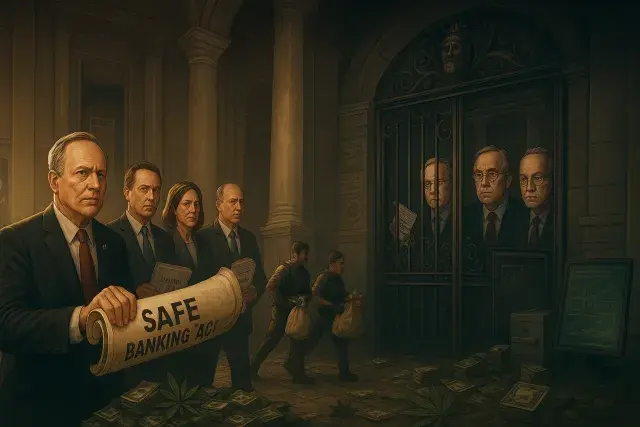

Gentner Drummond wants Oklahoma Republicans to elevate him to governor in Tuesday's runoff. He also chairs the parent company of Blue Sky Bank, an Osage County institution that has grown roughly sixfold since medical marijuana legalization, from about $200 million in assets in 2018 to more than $1.3 billion today. That growth arc, and the fact that it belongs to the state's chief law enforcement officer, is not a matter of speculation. It's in FDIC filings and on the bank's own leadership page.
Here's the catch for anyone in banking or cannabis retail watching this race: marijuana remains a Schedule I substance under federal law, which means most dispensaries and cultivators still can't get a standard business checking account from a nationally chartered bank. That gap created an opening, and Blue Sky Bank built a genuine niche around it, advertising a "Canna-Direct" account, armored cash pickup, and a service map covering nearly 30 states. Multistate operators managing compliant packaging, wholesale menus, and delivery manifests across state lines know how thin that market of willing banks actually is; the same operational reality that makes platforms like dispensary management software connecticut useful for seed-to-sale tracking and inventory reconciliation is exactly why cannabis-friendly banking became such a lucrative specialty in the first place. dispensary management software connecticut
That specialty, though, sits uneasily next to Drummond's other job. As attorney general, he decides who gets prosecuted for cannabis-related violations and who doesn't. As bank chairman, he profits from the deposits of licensed operators his office is supposed to police. Those two roles occupying one man invite an obvious question: whose interest wins when they collide?
Cash Businesses and the Compliance Gap
Cannabis retail's cash-heavy nature is not new to anyone in the industry. Federal banking restrictions under the Controlled Substances Act have long forced dispensaries to operate with limited access to cashless payments, armored transport, and standard merchant services, pushing many operators toward workarounds that regulators watch closely for structuring, meaning cash deposits broken into amounts designed to duck federal reporting thresholds. This column has received detailed claims from multiple sources describing exactly that pattern, cash allegedly moving across state lines and landing in banks that feed into Blue Sky. No one has produced a route, a name, or a documented deposit. That absence of proof is precisely why an independent audit, not a press release, is the only way to close the question.
PPP Loans and the Optics Problem
During the pandemic, three Drummond-affiliated businesses received a combined $3.6 million in forgivable Paycheck Protection Program loans across two rounds. The second round ran through Blue Sky Bank, which collected processing fees for administering loans to its own chairman's companies. Nothing here is illegal. But the timing lands during the exact stretch when the bank's cannabis-fueled balance sheet was expanding fastest, and that overlap is the kind of appearance problem compliance officers in any regulated industry are trained to flag on sight.
Rescheduling Changes the Math
The federal move to reschedule marijuana from Schedule I to Schedule III changes the economics for every licensed operator carrying 280E tax exposure, since operators taxed on gross revenue instead of net profit have absorbed that penalty for years. Removing it frees up real capital, capital that flows through banks like Blue Sky. Drummond hasn't said publicly what that shift does to his bank's cannabis deposits or his family's stake in it. Voters deciding between him and his runoff opponent deserve that number before Tuesday, not after.