
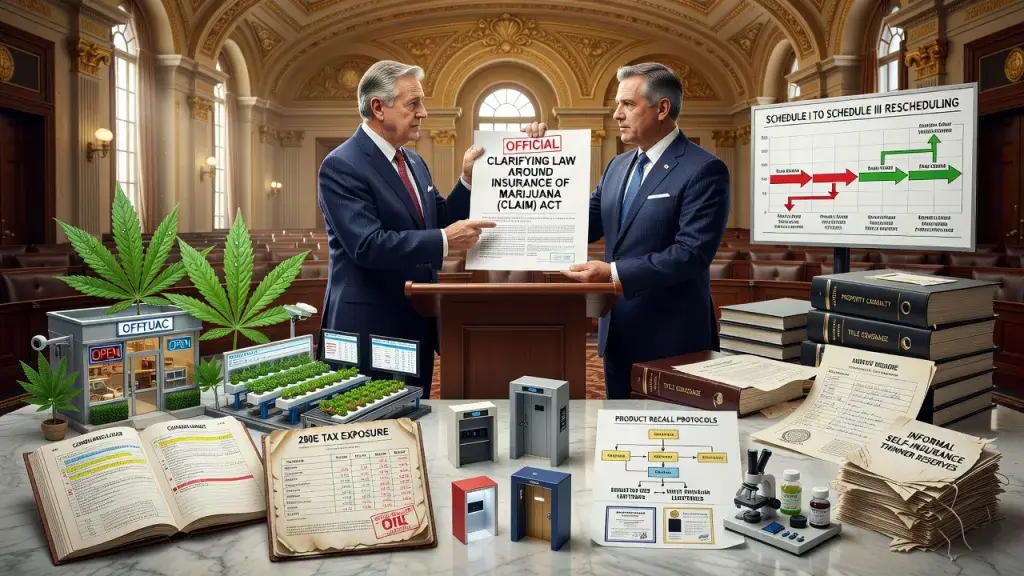
A bipartisan pair of U.S. senators has filed legislation that would give insurance companies, brokers and agents a federal safe harbor for underwriting policies to state-licensed marijuana businesses. Sens. Kevin Cramer (R-ND) and Ruben Gallego (D-AZ) introduced the Clarifying Law Around Insurance of Marijuana (CLAIM) Act on Tuesday, marking the fourth consecutive Congress in which some version of the bill has surfaced. The text tracks closely with prior editions, which tells you something about where the real obstacle sits - not with the policy language, but with getting it to a floor vote.
The mechanics matter here for anyone running store operations. Cannabis companies already juggle seed-to-sale tracking, 280E tax exposure and compliance logs that would make a traditional retailer wince, and doing all of that without standard commercial insurance access adds another layer of operational risk that most industries never have to think about. Property, casualty and title coverage remain difficult to secure because federal regulators can, at least in theory, treat insurers as facilitating a Schedule I substance. That exposure has pushed some carriers to avoid the sector entirely, which in turn complicates financing - lenders routinely want proof of insurance before extending capital for build-outs, equipment or inventory. Operators managing multi-location footprints, particularly in mature adult-use markets, often lean on platforms like dispensary management software colorado to keep compliance documentation, inventory shrinkage data and audit trails organized enough to satisfy whatever underwriting scrutiny does exist. dispensary management software colorado
What the Bill Actually Changes
The CLAIM Act would bar federal agencies from penalizing insurers simply for covering marijuana-related businesses, and it would stop insurers from being forced to cancel or restrict policies purely because a client operates in the cannabis space. It extends the same liability shield to insurance company employees, addressing a quieter fear inside the industry - that underwriters or claims adjusters could face individual exposure just for doing their jobs. The bill also directs the Government Accountability Office to study licensing and financial-services barriers facing minority-owned and women-owned cannabis businesses, a nod to social equity concerns that have dogged state licensing programs for years.
Why Insurance Access Is a Safety Issue, Not Just a Business One
Insurance gaps are not simply a balance-sheet problem. Dispensaries and cultivation sites that operate without adequate coverage have less incentive, and less financial cushion, to invest in the kind of security infrastructure, product recall protocols, and lab-testing verification that protect consumers. When a business can't get standard liability coverage, it often self-insures informally, which tends to mean thinner reserves for handling a contamination event, a COA discrepancy or a store break-in. Better insurance access, in that sense, functions as a quiet consumer-protection mechanism as much as a commercial one.
The Bigger Regulatory Picture
This bill lands alongside other movement in Washington. Last month, lawmakers filed a related measure aimed at protecting banks that serve cannabis operators, and the Trump administration is separately advancing a process to reschedule marijuana from Schedule I to Schedule III. A DEA administrative law judge recently closed testimony in that rescheduling proceeding, with final briefs due August 17 before a recommendation moves up the chain. None of this guarantees swift change - prior CLAIM Act versions stalled for three straight Congresses - but the convergence of insurance, banking and scheduling reform efforts suggests the industry's compliance and risk infrastructure will keep evolving, whether or not any single bill clears both chambers this session.