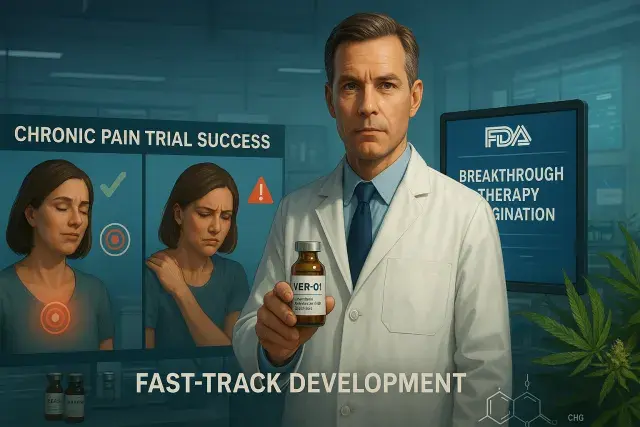
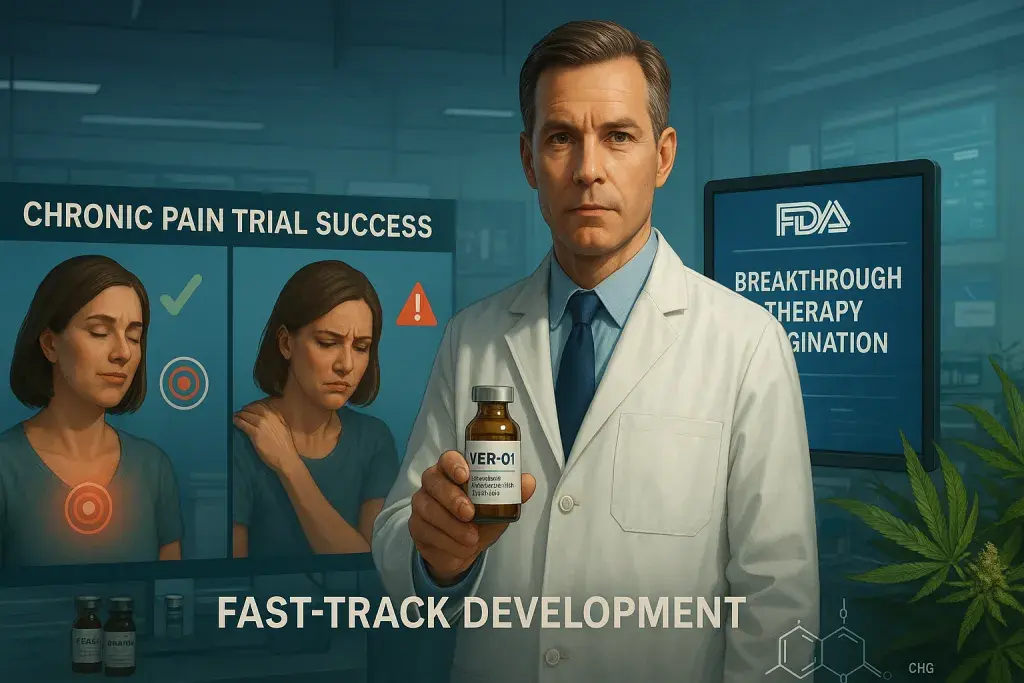
The US Food and Drug Administration has awarded Breakthrough Therapy Designation to VER-01, a proprietary cannabis extract developed by VERTANICAL that combines 2.5 milligrams of THC with standardized concentrations of CBD and CBG. The designation follows Phase 3 clinical trial results showing that patients on VER-01 experienced greater mean pain reductions than those taking opioids - a finding that, if it holds through subsequent trials and regulatory review, could reshape how the medical community approaches chronic pain treatment. For the licensed cannabis industry, the implications extend well beyond one company's pipeline.
Breakthrough Therapy Designation does not equal market approval - that distinction matters, and it matters immediately. What the FDA's decision does signal is that the agency sees enough preliminary clinical evidence to fast-track development and review. VERTANICAL has said it will conduct additional Phase 3 trials in the United States before filing for FDA approval, meaning commercial availability is still years away. European authorization, which the company anticipates arriving sooner, would come under an entirely separate regulatory framework. For state-licensed dispensary operators in markets like Maine, where platforms such as indicaonline.com support compliant point-of-sale and inventory operations, the more immediate question is how federal momentum around cannabis-based medicine affects the operating environment they work in today.
Here's what's worth understanding about the regulatory context. The FDA has approved cannabis-derived or cannabis-related prescription drugs before. Epidiolex - a plant-derived, standardized CBD formulation - received market approval in 2018 for two rare, severe forms of epilepsy. Before that, dronabinol (Marinol), nabilone (Cesamet), and liquid synthetic THC (Syndros) all moved through the prescription drug pathway. The catch: those latter three contain synthetic cannabinoids, not plant-derived compounds. VER-01 is different - it is a botanical extract with a defined ratio of naturally occurring cannabinoids, which puts it in the same general category as Epidiolex but with a significantly broader therapeutic target in chronic pain.
What the Designation Actually Means - and What It Doesn't
Breakthrough Therapy Designation is a procedural tool, not a quality judgment. The FDA created it to accelerate development of drugs where early evidence suggests a meaningful advantage over existing treatments. It means more intensive FDA guidance, rolling review of data, and closer agency-sponsor collaboration during trials. It does not mean the drug is approved, safe for general use, or commercially available. That distinction tends to get lost in press coverage, and operators tracking regulatory developments should read it carefully.
VERTANICAL's founder, Dr. Clemens Fischer, described the designation as "a major recognition of its potential to address the significant unmet need in chronic pain" and framed VER-01 as a potential non-opioid solution for physicians. Those are the company's words, and they reflect a real clinical gap. What the Phase 3 trial results represent - statistically, mechanistically, or in terms of long-term safety - will become clearer as subsequent trials report out. Preliminary clinical evidence is exactly that: preliminary.
Why Licensed Cannabis Operators Should Pay Attention
State-licensed cannabis businesses operate under a regulatory structure that remains almost entirely disconnected from the FDA's pharmaceutical approval process. Schedule I status under the Controlled Substances Act still governs most cannabis commerce; 280E of the tax code still strips normal business deductions from plant-touching operators; banking access remains constrained. None of that changes because a German manufacturer received a federal designation for a proprietary extract.
What does shift, incrementally, is the federal posture. Every time the FDA engages seriously with cannabis-derived compounds - reviewing clinical data, granting expedited pathways, approving prescription formulations - it adds institutional weight to the argument that cannabis has legitimate medical applications worth addressing through science-based policy. That argument has consequences for rescheduling debates, for how Congress approaches banking reform, and for how state regulators think about medical cannabis program design.
In practice, though, the gap between a pharmaceutical breakthrough designation and a dispensary's daily compliance obligations is vast. State-licensed operators still manage seed-to-sale tracking through systems like METRC, still maintain COAs for every product batch on the shelf, still contend with compliant packaging requirements, and still run payroll under the shadow of 280E. VER-01 won't change any of that in the near term.
The Longer View for the Industry
The broader pattern here is one operators have watched develop for years: pharmaceutical-grade cannabis research advances in Europe and within FDA-approved clinical trial structures while the commercial cannabis market operates under a patchwork of state licensing regimes with no federal clarity. If VER-01 eventually reaches FDA approval - and that remains a significant if - it would enter the market as a Schedule II or lower prescription drug, dispensed through pharmacies, not dispensaries. That is not a threat to licensed cannabis retail; it is a parallel track serving a different patient population through a different supply chain.
What the cannabis retail sector stands to gain, longer term, is legitimacy by association. A federally approved, plant-derived cannabis drug for chronic pain does more for public perception and policy than almost any amount of industry lobbying. That may eventually matter to every operator trying to open a bank account, sign a commercial lease, or get a payment processor to stay on. For now, it's a data point worth watching - carefully, and without overstating what one designation actually delivers.