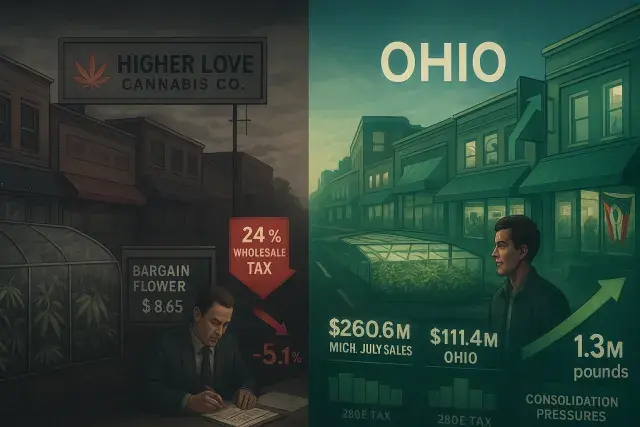
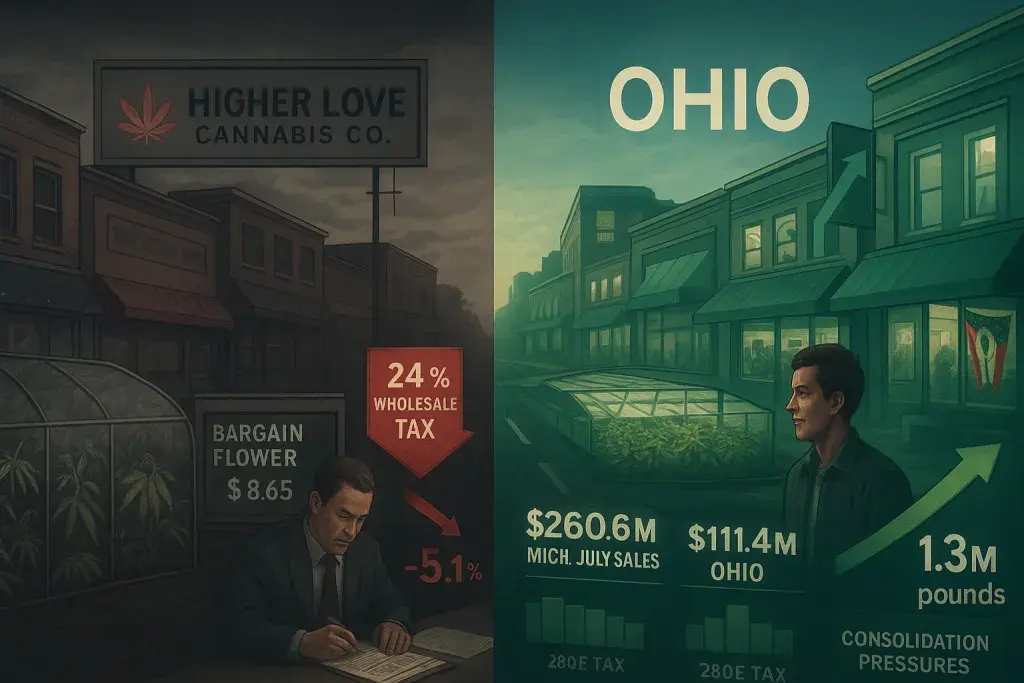
Michigan's marijuana industry, long the volume leader of the Midwest, is showing real cracks. Sales fell 5.1% year over year in July even as Ohio's much younger recreational market jumped 22%. The divergence has reopened a fight in Lansing over the state's 24% wholesale marijuana tax, and it's putting a harder question on the table: is Michigan's tax structure undermining an industry that was supposed to be a national model?
A Market Built on Volume, Not Margin
Michigan still moves far more product than Ohio - $260.6 million in July retail sales compared with roughly $111.4 million across the border. But the average item price in Michigan sat at just $8.65 last month, the lowest among major U.S. markets tracked by Headset. That's the product of years of oversupply: cultivation licenses outpacing retail demand, wholesale menus flooded with flower, and dispensaries competing on price because there isn't much else left to compete on. Consumers have benefited enormously. Operators, not so much. Thin margins mean less room to absorb a new tax, and less room to absorb a bad quarter.
The Wholesale Tax Lands on Compressed Margins
Michigan's 24% wholesale tax, in effect since Jan. 1, sits on top of the existing 10% excise tax and 6% sales tax consumers already pay at the register. State officials projected roughly $420 million a year in revenue for road funding. Rep. James DeSana says the numbers aren't materializing - he's pointed to a shortfall of roughly $70 million in the first four months of the fiscal year - and has introduced House Bill 6224, a one-sentence repeal of the law. The bill is now sitting in House Appropriations, and the tax itself remains under legal challenge from industry groups.
Here's the mechanism worth understanding for anyone running budroom inventory or setting wholesale pricing: a tax on wholesale transactions doesn't just add a line item. It compresses the margin between cultivator and retailer at exactly the point in the supply chain where 280E already limits what cannabis businesses can deduct on federal taxes. Add a state-level wholesale levy to a market where flower is already selling for pennies on the gram, and the math stops working for a lot of operators - particularly smaller, single-state companies without the balance sheet to ride out a bad stretch.
Closures in the Upper Peninsula Signal Broader Strain
Higher Love Cannabis Co. suspended operations at five of its nine Michigan dispensaries in August, citing the wholesale tax as an added cost on top of oversupply and falling prices. The company said the pressure has pushed cannabis businesses statewide toward consolidation, facility suspensions and job cuts. Notably, this isn't a demand problem. Michigan dispensaries remain on pace to sell more than 1.3 million pounds of flower in 2026, roughly matching last year's volume, according to Cannabis Regulatory Agency data. Consumers bought more than 30 million individual products in July alone. The issue is that record volume at rock-bottom prices doesn't generate the revenue operators need to cover rent, payroll, compliance costs and now a wholesale tax bill.
License data hints at the contraction already under way. Michigan had 836 active adult-use retail licenses and 939 active cultivation licenses as of June 30, down from 845 retail and 1,016 cultivation licenses a year earlier. Growers appear to be exiting faster than retailers, which tracks with an oversupplied wholesale market where cultivation has been the least profitable link in the chain.
What a Narrowing Price Gap Could Mean
Ohio's market looks almost like Michigan's mirror image: younger, smaller, and considerably more expensive, with an average item price near $30 - more than three times Michigan's. That price gap has historically pulled Ohio consumers across the state line. But if Michigan's tax burden keeps squeezing growers and retailers out of business, supply could tighten and prices could drift upward. Ohio, meanwhile, is expanding cultivation and retail capacity, which tends to push prices down over time. If those trends continue, the pricing gap between the two states could narrow - and that would reshape competitive dynamics along the entire Michigan-Ohio border, affecting everything from retail site selection to wholesale contracts.
For operators, wholesalers and landlords watching this play out, the underlying lesson isn't really about one tax bill. It's that regulators can build a market with plenty of consumer demand and still watch the businesses supplying it struggle to survive. Lansing wanted road money. What it may get instead is a smaller, more consolidated industry generating less taxable revenue than the projections assumed - right as a competitor builds momentum next door.