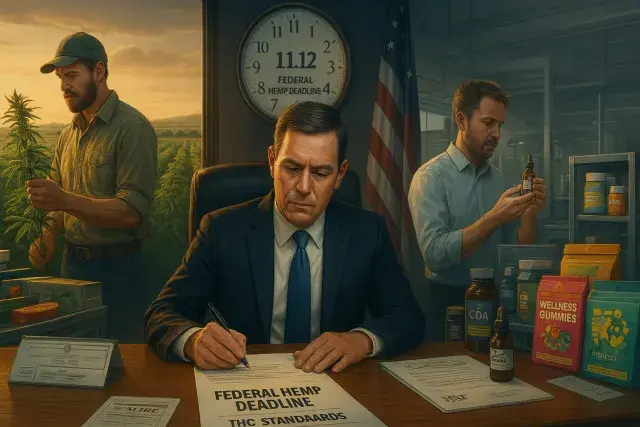
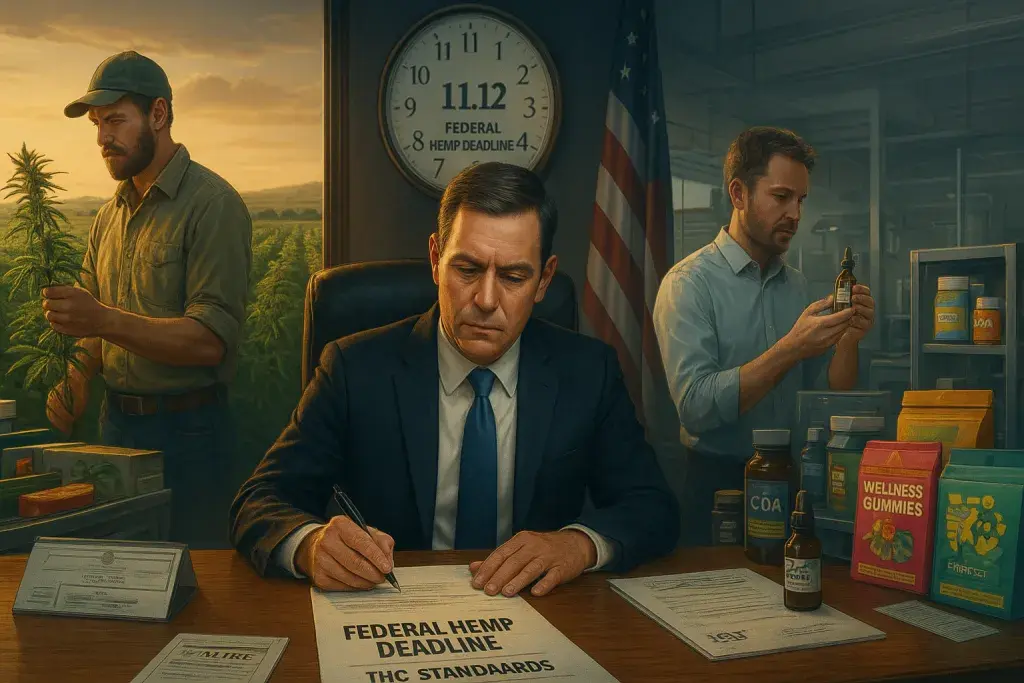
Pennsylvania Attorney General Dave Sunday has joined more than 30 counterparts nationwide in pressing Congress to let a sweeping redefinition of hemp take effect as scheduled on Nov. 12, rather than delay it further. The letter frames the change as a public-safety fix for a regulatory loophole that has let intoxicating delta-8 and delta-10 products flow into gas stations and convenience stores with little oversight. But the fix, as written, would also sweep up a large share of Pennsylvania's licensed hemp economy, including growers and processors who never touched an intoxicating product to begin with.
That tension is the real story here, and it's one every cannabis-adjacent operator should be tracking closely, regardless of state. The 2018 Farm Bill drew the hemp-marijuana line at 0.3% delta-9 THC measured at harvest - a threshold that said nothing about what happens once raw plant material gets processed into a gummy, tincture, or beverage. Congress's new language closes that gap by shifting to a total-THC standard and capping finished containers at 0.4 milligrams, effectively criminalizing a wide swath of consumer products overnight. For multi-state operators already juggling seed-to-sale tracking, COA management, and compliant packaging across different jurisdictions, this is one more variable to model into inventory and SKU decisions before the deadline hits. Retail and hospitality operators watching how compliance infrastructure evolves in emerging markets have seen similar recalibration play out elsewhere - the rollout of Metrc-compliant POS for Northern Mariana Islands operators is a useful reminder that traceability systems and product-definition rules tend to move together, not separately.
Why the Container Standard Is the Sticking Point
The industry's objection isn't really about intoxicating products - most hemp advocates, including Lancaster-based manufacturer Endo and its president Jake Sitler, say they want regulation, not a free-for-all. The objection is that the container-level THC cap doesn't distinguish between a product designed to intoxicate and a CBD tincture marketed as a sleep aid with no meaningful psychoactive effect. Under the new milligram threshold, both could land in the same illegal category. That's a compliance nightmare for retailers stocking wellness-oriented SKUs, and it's a existential problem for the growers supplying that segment of the wholesale menu.
What's at Stake for Growers and Processors
Pennsylvania's Department of Agriculture has licensed 170 hemp growers and 32 processors, and roughly half of that grower base sells into consumable manufacturing - the exact segment the new rule would hit hardest. Adams County farmer Tyler Shannon, who sells around $400,000 in hemp annually for CBD use, put it plainly: none of his crop goes toward intoxicating products, yet his entire business model could collapse under the redefinition. Industrial hemp fiber and grain - the stuff that ends up in textiles, bioplastics, paper, and animal feed - is exempted. Consumable hemp is not, and that's where the U.S. Hemp Roundtable's warning about a 95% marketplace wipeout comes from.
The Regulatory Gap Enforcement Actually Wants Closed
District attorneys across Pennsylvania say the current ambiguity makes it nearly impossible to police products marketed toward minors through cartoonish packaging and candy-adjacent branding. Sunday's office has argued that a uniform federal standard would let law enforcement act with clarity instead of case-by-case interpretation, and several states have already written the current federal hemp definition directly into their own statutes - meaning a last-minute delay in Washington could leave state-level enforcement frameworks in limbo. That's the chaos scenario the attorneys general are trying to avoid, even as it collides with the economic reality facing licensed hemp businesses.
A Narrow Window for a Legislative Fix
Sitler's argument, echoed by other operators, is that pulling intoxicating products off unregulated shelves without a replacement framework just pushes demand toward the black market - the same dynamic regulators have watched play out in alcohol and cannabis retail for decades. A short delay, tied to the Senate's stopgap funding bill, wouldn't undo the Nov. 12 deadline outright; it would buy time for Congress to separate genuinely intoxicating products from low-THC consumables before the rule locks in. Whether that compromise survives the current funding fight is still an open question, and operators on both sides of the hemp-cannabis divide are watching Washington closely for the answer.