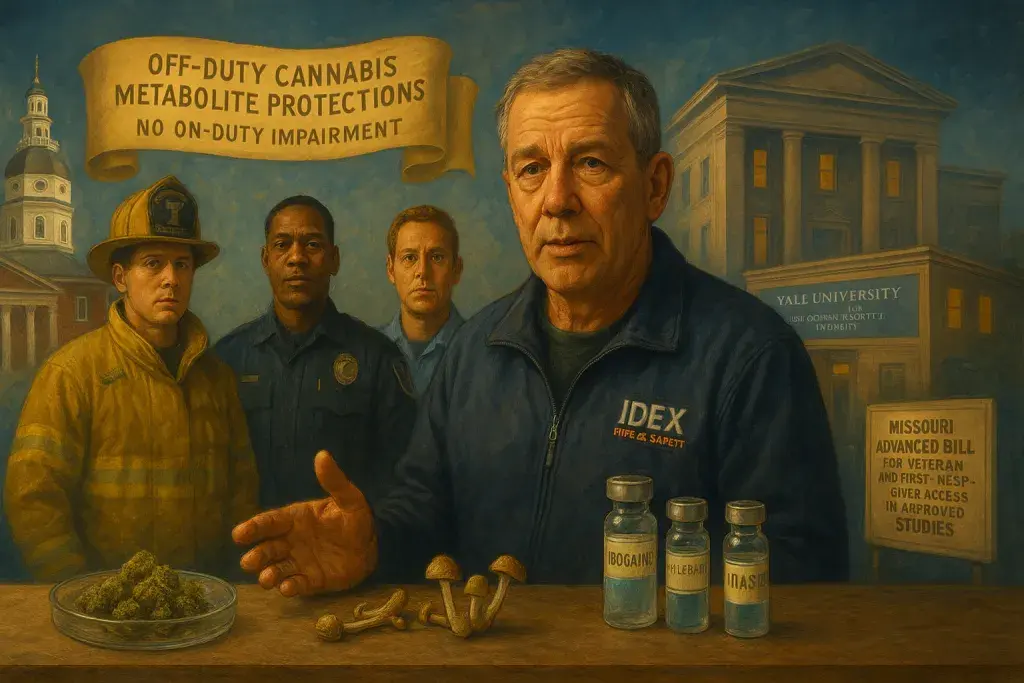
A quiet but meaningful shift is underway in how states approach mental health support for first responders - and medical cannabis is part of that conversation. Several state legislatures this year have enacted or advanced measures that move beyond conventional therapy and pharmacology to address post-traumatic stress in firefighters, police officers, paramedics, and emergency medical workers. The policy activity spans medical cannabis employment protections, emerging psychedelic research programs, and new state-funded treatment review commissions.
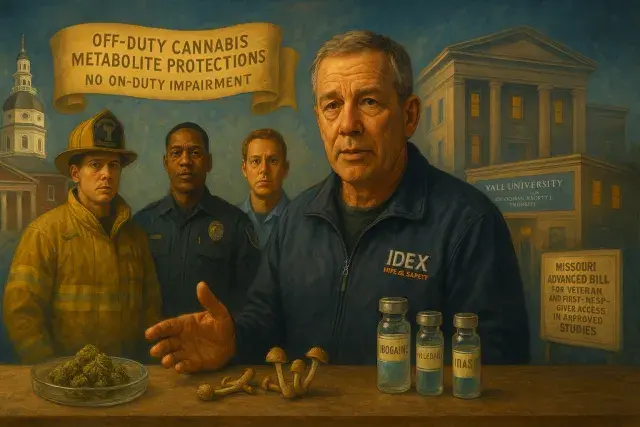
Maryland's approach is the most directly relevant to licensed cannabis operators. A new state law - effective this October - prohibits employment discrimination against firefighters, EMTs, paramedics, and other rescue workers who are registered medical cannabis patients and test positive for cannabis metabolites while off duty, provided they are not impaired while on the job. For dispensary operators and compliance teams watching how Maryland regulators handle medical cannabis patients in the workforce, their platform reflects an environment where patient protections are expanding even as on-duty impairment standards remain firm. The distinction matters: the law doesn't soften workplace safety requirements - it carves out specific protection for lawful off-duty use, which is a meaningful but narrow shield.
Ohio took a different structural route. Republican Gov. Mike DeWine signed legislation creating a Post-Traumatic Stress Injury Commission that will review applications from eligible first responders and help cover treatment costs. The commission model doesn't mandate a specific therapy; it creates a funded gateway. That design leaves room for the approved treatment mix to evolve as clinical evidence accumulates - including, potentially, therapies that involve regulated substances.
Psychedelic Research Enters the Policy Frame
Connecticut and Missouri both advanced measures touching on psilocybin-assisted therapy and, in Missouri's case, ibogaine as well. Connecticut expanded eligibility for a Yale University pilot program studying psilocybin-assisted therapy - previously limited to veterans, retired first responders, and frontline health care workers - to any state resident age 18 or older who meets the clinical criteria set by Yale's institutional review board. Missouri's legislature advanced a bill that would allow veterans and first responders in approved research studies to access psilocybin and ibogaine under medical supervision for PTSD and related conditions. The bill didn't reach the governor before the legislature adjourned in May.
These aren't legalization measures. They're tightly scoped research frameworks operating under institutional oversight. The distinction is worth holding onto. What they represent for regulated cannabis markets is more indirect: they signal that state legislators are increasingly willing to separate the question of "what helps patients" from the political history of any given controlled substance. That broader receptiveness shapes the regulatory climate in which medical cannabis programs operate.
What This Means for Dispensary Operators and Medical Cannabis Programs
The Maryland employment protection law has practical implications for how medical cannabis retailers and their B2B partners think about patient populations. First responders represent a significant subset of the adult working population - and historically, employment risk has been a documented barrier to medical cannabis registration. If that barrier shrinks, patient enrollment in medical programs could increase. That's a supply chain and inventory planning consideration, not just a policy footnote.
Here's the catch, though: the law protects against discrimination over a positive metabolite test - not impairment. It does not change on-duty conduct standards. Dispensary staff and compliance officers advising medical patients should understand that gap precisely. Cannabis metabolites can remain detectable long after any psychoactive effect has dissipated; that's a pharmacological reality, not a loophole. Patients, employers, and the broader medical cannabis ecosystem all benefit when that distinction is communicated clearly and accurately.
Jason Cerrano, a retired Missouri firefighter and paramedic with more than two decades of experience who now works in commercial research and development at IDEX Fire & Safety, put the underlying problem plainly: in first responder culture, repeated exposure to trauma normalizes experiences that most people would find unbearable. That psychological accumulation doesn't resolve on its own. States are responding - and the tools they're reaching for increasingly include the regulated substance sector.
The Broader Regulatory Signal
Across these four states, the legislative activity reflects something operators in adult-use and medical cannabis markets have watched develop gradually: state governments are expanding the acceptable therapeutic context for regulated substances, and they're doing it incrementally and with institutional safeguards in place. None of these laws create open commercial markets for new substances. What they do is widen the range of settings in which those substances can be studied or used lawfully - and that regulatory architecture tends to inform future policy.
For licensed cannabis businesses, the near-term opportunity isn't abstract. Employment protection laws for medical patients reduce the deterrent to registration. State-funded treatment commissions create formal channels through which cannabis could eventually be included as a reimbursable therapy. And the growing clinical infrastructure around psilocybin research establishes a precedent model - supervised, institutionally reviewed, evidence-focused - that medical cannabis advocates have argued for since the earliest state programs launched.
None of this moves fast. But the direction is consistent.