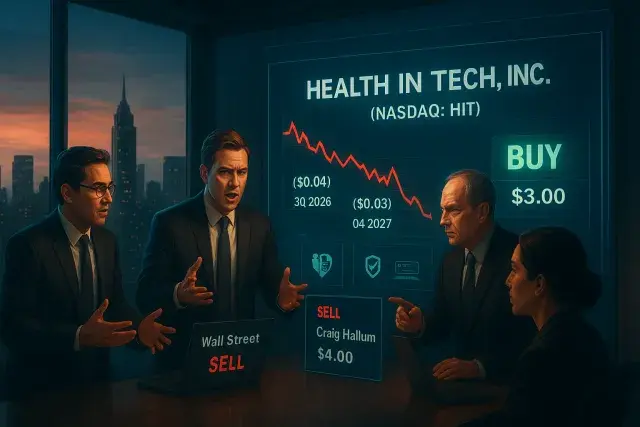
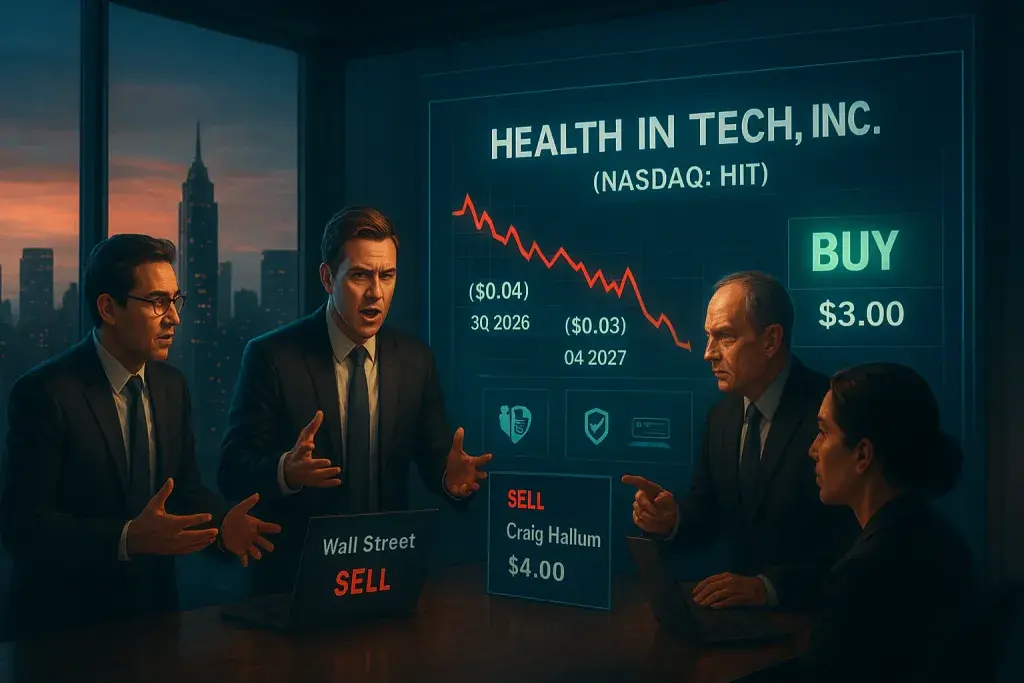
Health In Tech, Inc. (NASDAQ: HIT) is drawing a mixed but active round of coverage from Wall Street, with Maxim Group issuing a fresh set of quarterly loss estimates that stretch out through fiscal 2027. The research note, published Friday, August 14th, projects continued per-share losses for the insurtech company well into next year, even as the firm's analyst maintains a "Buy" rating and a $3.00 price target. For a company still working through the operational growing pains that come with scaling a health-insurance distribution model, that combination - bullish rating, red ink on the books - is worth sitting with for a moment.
The numbers themselves tell a story of incremental improvement rather than a clean turnaround. Maxim's A. Klee expects a loss of ($0.04) per share for Q3 2026, narrowing slightly to ($0.03) in Q4, before the company reaches breakeven territory in early 2027 with a projected $0.01 EPS. That's followed by another dip back into loss territory later in the year. It's the kind of jagged, non-linear path that shows up often in companies still refining unit economics, adjusting distribution costs, or absorbing technology investment ahead of revenue catching up. Operators in adjacent regulated industries - cannabis retail chief among them - will recognize the pattern. Building out infrastructure, whether that's insurance underwriting platforms or a cannabis retail technology platform new york dispensaries rely on for compliance and point-of-sale functions, tends to front-load costs long before margins normalize. cannabis retail technology platform new york
Divergent Analyst Views Signal Real Uncertainty
What's striking here isn't just the loss projections - it's how far apart analysts have landed on the stock's fundamental value. Wall Street Zen downgraded Health In Tech from "hold" to "sell" back in April, a notably bearish call. Weeks earlier, Craig Hallum initiated coverage with a "Buy" rating and a $4.00 price target, the most optimistic figure among the group. Weiss Ratings, meanwhile, restated a "sell (d)" rating as recently as late June. Three analysts, three distinct read on the same balance sheet. That spread matters for anyone evaluating the stock, because a consensus rating of "Moderate Buy" with an average target of $3.50 can mask just how contested the underlying thesis really is.
In practice, this kind of analyst divergence often reflects genuine disagreement over execution risk rather than differing data. One camp is betting on the company's ability to convert its platform and distribution reach into sustainable revenue; another is more skeptical that near-term losses will resolve on the timeline management or bullish analysts suggest. Investors weighing the stock should treat consensus targets as a starting point, not a verdict.
Why the Loss Trajectory Matters Beyond the Ticker
Sustained EPS losses, even modest ones, put pressure on cash reserves, financing terms, and how much runway a company has to prove out its model before needing to raise capital again. For a small-cap name trading on projections rather than established profitability, every quarterly print becomes a data point that either supports or undercuts the bull case. Fair enough - that's true of most growth-stage companies. But it's worth remembering that a "Buy" rating paired with years of projected losses is a statement about long-term conviction, not a promise of near-term stability. Shareholders and prospective investors should read these estimates as directional guidance from one research shop, not a guarantee of outcome, and weigh them against the more skeptical calls from Wall Street Zen and Weiss Ratings before drawing conclusions.